The origins of Domaine Hoppenot
The importance of origins
At just 38 years old,Grégoire Hoppenotdecided to leave his job as a wine merchant to launch his own production in 2018. Following the sale of the plots ofFlowerywhose strong potential he was aware of,Grégoire HoppenotHe acquired them without hesitation. His new life got off to a flying start, as he was quickly noticed, eventually becoming "Discovery of the Year 2021" by RVF (La Revue du Vin de France). His love for the Beaujolais region and his desire to reconnect with the origins of winemaking led him to become this promising new winemaker. His philosophy is simple: to give paramount importance to the quality of the terroir, and above all, to enhance it.
In a constant quest for innovationGrégoire Hoppenotis also in organic conversion since 2018. This project, which is planned for5 yearsThis is not an easy task, as the land is not particularly suited to this type of farming. Difficult access to some plots, or simply the high cost of this transition, complicates matters, butGrégoire HoppenotHe remains nonetheless convinced of the benefits that...organic farmingwill bring it to him.
A terroir with great potential
In the Beaujolais region
The vineyard ofHoppenot Estateextends over an area of9.5 hectaresThe vines are mostly planted in the goblet style and at high density (10,000 vines per hectare), which is relatively common in theBeaujolaisThe soils of the plots are predominantly composed ofsandas well asshallow granite rock.
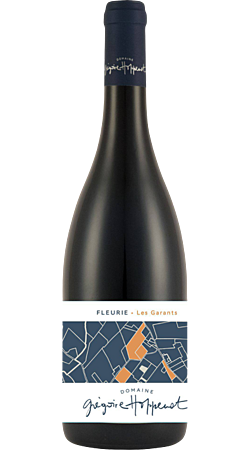
Regarding the 4 plots of Garants, the vines are between 25 and 60 years old and are located on the same hillside, facing south-southwest, at an altitude of 290 to 330 meters.
The Moriers plot is located at an altitude of between 260 and 340 meters, facing East to Northeast. The vines are between 30 and 90 years old.
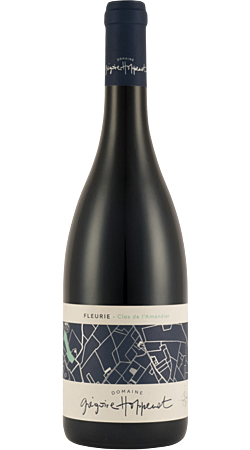
The vines in the Clos de l'Amandier plot, which are between 15 and 30 years old, are a monopoly of the estate, located at the southeastern end of the Poncié climate, at an altitude of 280 to 395 meters.
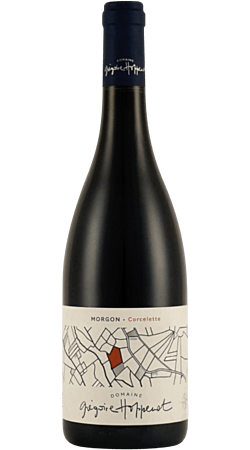
The Morgon-Corcelette plot, on the other hand, has a very steep slope, facing south to southwest, at an altitude of between 370 and 400 meters. The vines are between 20 and 30 years old.
Finally, the Roches plot, east of Moriers, faces east and has an altitude of between 260 and 330 meters. The vines are between 3 and 50 years old.
Winemaking at Domaine Hoppenot
Traditional work done with the utmost respect for the land.
Although the area is not yet fully converted to organic farming,Grégoire HoppenotHe constantly draws inspiration from numerous references with the aim of continually innovating. His passion for wine and his philosophy instill such respect in the vines that all his vintages are promising.
The grapes are harvested by hand, and the wines are made without thermovinification in order to express the terroir as faithfully as possible. Fermentation and extraction take place at a temperature of 30°C to slow their rate.