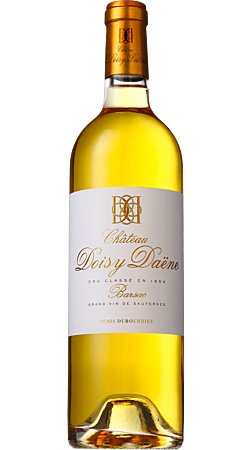
A passion for Sauternes
The history of Doisy-Däene Castle
The history of theChâteau Doisy-Däeneas a wine estate. Thanks to his marriage, Jean Védrines acquired the management of the château, where he planted vines. Located in the locality of Doisy, in the region ofSauternesIn the Bordeaux region, the château was divided during the reign of Napoleon I. The owner at the time, Jean-Jacques Emmanuel Däene, saw this as an opportunity to add his surname to the château's name. It was therefore under the name Château Doisy-Däene that the property was classified in 1855 as a second growth.
Georges Dubourdieuacquires the Castle in1924and will continue to develop the estate. His son Denis takes over. Dedicated to viticulture and the preservation of Bordeaux's heritage, he has taught oenology at the University of Bordeaux since 1987. He is considered one of the masters of white winemaking. With his wife Florence, they maintain and enhance the vineyard until they pass it on to their children. TodayFabrice and Jean-Jacques, the two heirs, who are in charge of the estate.
The Sauternes terroir
a setting to house the Château Doisy-Däene
It is atBarsacthat extend the135 hectaresattached toChâteau Doisy-Däene.Regarding the appellationSauternesThe vineyards are lined with vines of Sémillon (86%), Sauvignon Blanc (13%), and Muscadelle (1%). Sémillon is the king of grape varieties in the appellation. Its thin skins allow for better ripening of thebotrytis cinereaSauvignon Blanc is responsible for noble rot, making it the ideal grape variety for sweet wines. Conversely, noble rot develops more slowly on Sauvignon Blanc, which is therefore used to produce dry and aromatic white wines.
The estate is unique in that for every hectare of vineyard, there is an equivalent area of forest. Thus, the trees and vines each cover 18.2 hectares. One hectare of clay-sand soil over limestone supports 700 vines. Located north of the plateau ofBarsacThe vineyard is cultivated using sustainable practices. Significant efforts are focused on the quality of viticulture. For example, the trees contribute to reducing the carbon footprint. Inputs are also reduced, and a transition towards aorganic farmingis driven.
The expertise of Château Doisy-Däene
The experience of teacher-researcher Denis Dubourdieu
In terms of viticulture, the vineyard is experiencing atraditional maintenance.The land is plowed with horses, and plant-based compost is used to fertilize the vines. Bud thinning, trellising, and leaf removal are carried out by the winemakers. After hand-harvesting and gentle pressing, the grapes are placed in barrels for fermentation. The small containers allow for better control of the alcohol compared to large vats. The estate prides itself on preserving this tradition. The winemaking process...Château Doisy-DäeneThe winemaking process is minimally interventionist. The aging process after malolactic fermentation is twofold. First, the wines are placed in barrels for 10 months. Then, the wines are aged in stainless steel tanks for 9 months. 60% of the production is destined for export.
The winemakers of theDubourdieu familyoffer wines of aaerial balance, between acidity and sweetness. Between fresh fruit and nervousness, these arepure wines,more than powerful, which reveal themselves upon tasting.